A business can be profitable every month of the year and still miss payroll, not because it isn’t making money, but because the cash isn’t there when it needs to be.
It’s a timing problem that catches even profitable companies off guard.
The pattern behind it is familiar: invoices go out late, bills get paid early, accounts haven’t been reconciled in months, and by the time the owner notices the shortfall, there’s barely enough cash to cover what’s due. Fixing it doesn’t always mean taking out another loan or hiring someone to manage the finances. Sometimes, it starts with better cash flow planning, knowing what’s coming in, what’s going out, and whether the money will be there when the next bill lands.
Below are seven proven strategies to improve cash flow, the metrics that show whether they are working, and answers to the questions owners ask most.
Key Takeaways
- Profit and cash are different. A profitable business can still run short when customers pay late and bills come due before the money arrives.
- A rolling 13-week forecast helps you plan ahead, showing potential cash shortfalls weeks in advance so you’re not caught off guard.
- The quickest wins often sit in receivables: invoice promptly, shorten payment terms where possible, and make it easier for customers to pay.
- Track a few useful metrics, like days sales outstanding and cash buffer days, so cash flow optimization becomes a regular habit rather than a last-minute reaction.
What Is Cash Flow, and Why Does Profit Not Pay the Bills?
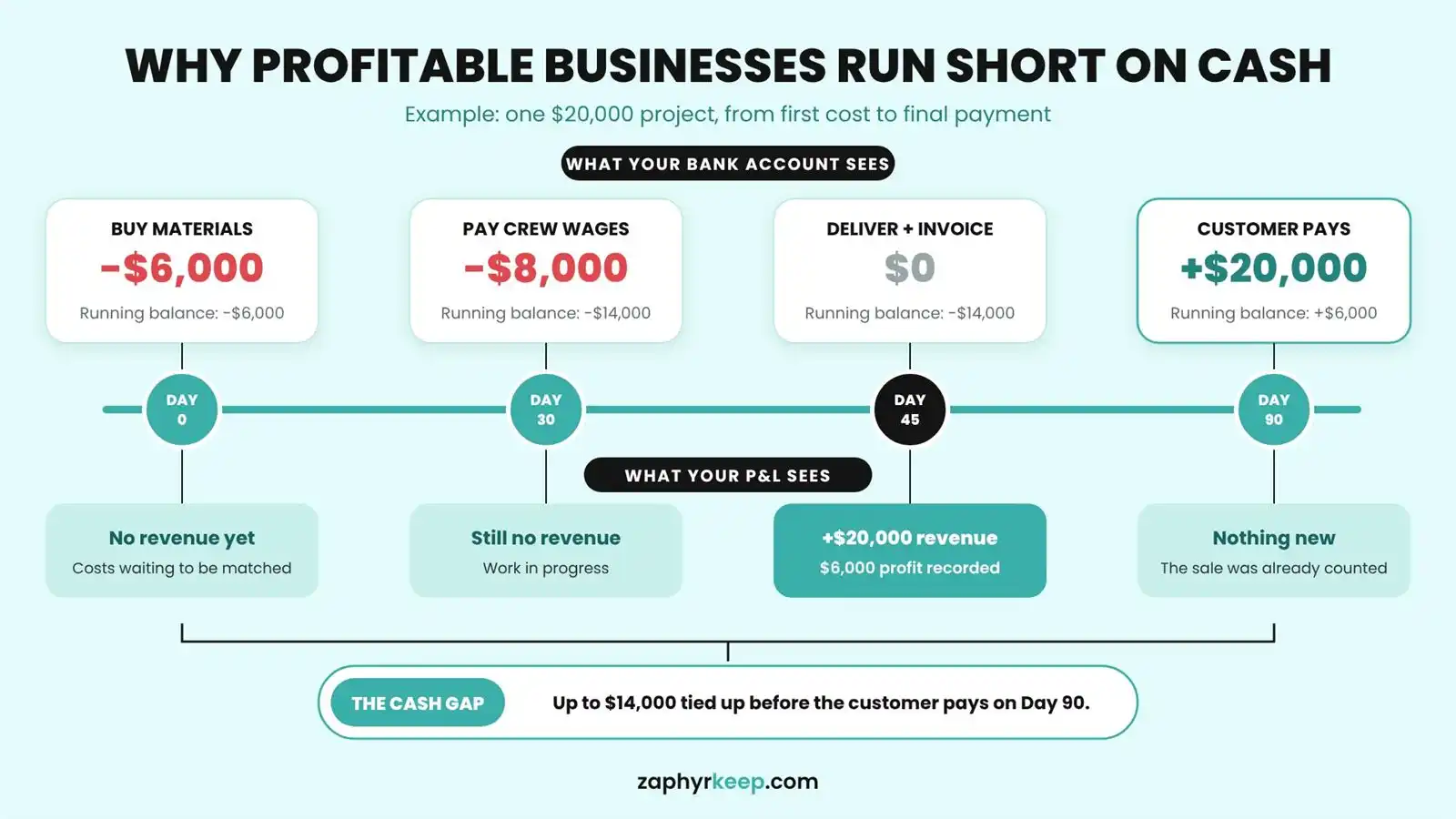
Cash flow is the movement of money into and out of your business over time, and it tells you how much cash is actually coming in compared to what you’re spending. Positive cash flow means more money comes in than goes out, while negative cash flow means the opposite. Profit, on the other hand, is an accounting result: revenue minus expenses, which under accrual accounting are recorded when earned or incurred, not necessarily when cash changes hands.
That difference is why growing businesses can feel the squeeze even when sales are climbing. Every new job may mean paying for materials and labor before the customer pays you, and the faster you grow, the more cash can get tied up in that gap.
If this sounds familiar, you’re not alone. In the Federal Reserve Banks’ 2026 Report on Employer Firms, 50% of respondents reported uneven cash flow, including collecting on receivables, as a financial challenge in the prior 12 months. Among firms facing financial challenges, 54% had turned to the owner’s personal funds to get through. Better cash flow planning helps you spot those gaps early and prepare for them before they catch you off guard.
7 Proven Strategies to Improve Cash Flow
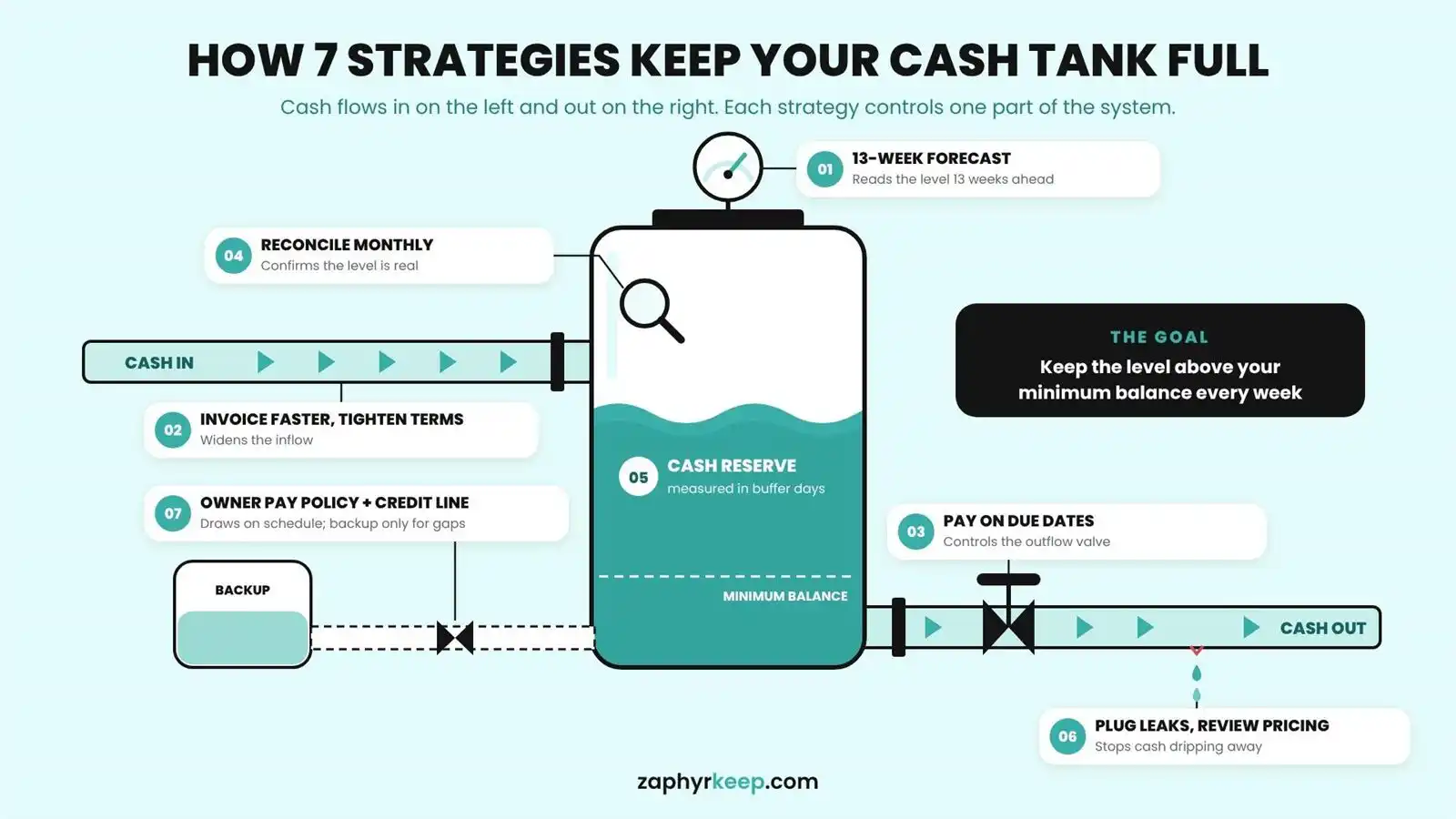
Each strategy works on one of three levers: bringing cash in faster, sending it out more deliberately, or protecting what you already hold. They work best together as one cash flow optimization plan rather than seven separate tips.
1. Build a Rolling 13-Week Cash Flow Forecast
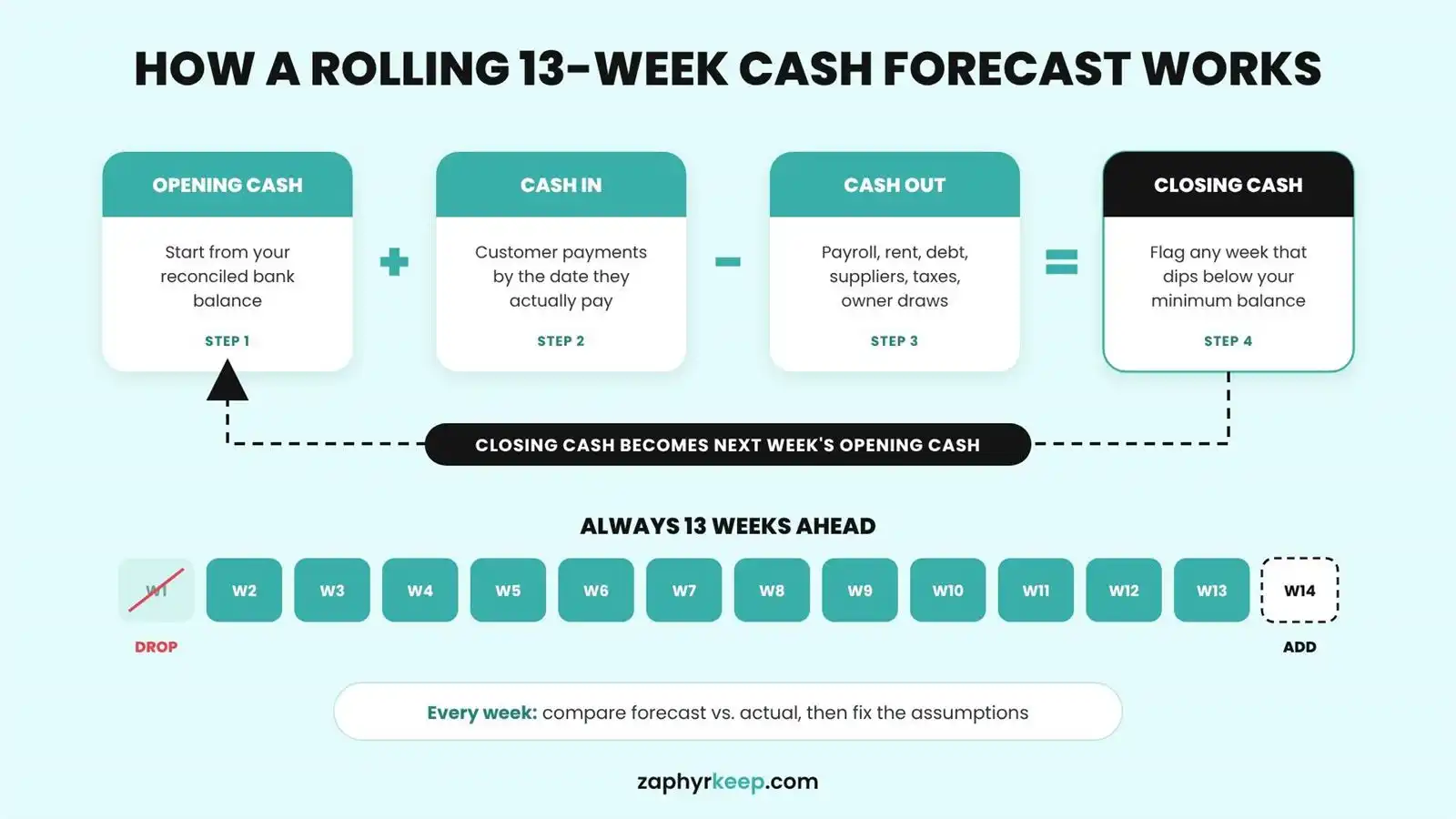
Every other strategy works better when you can see what’s coming. A 13-week forecast is a useful starting point for cash flow planning in small businesses, giving you enough time to spot a payroll crunch or an upcoming tax payment without looking so far ahead that the numbers become guesswork.
A reliable forecast follows the same structure every time:
- Start with real cash. Use this week’s opening balance from your reconciled bank accounts.
- Add expected inflows week by week. Base customer payments on when each customer is likely to pay, not just the invoice due date.
- Subtract expected outflows. Include payroll, rent, loan payments, supplier bills, estimated taxes, and owner draws where applicable.
- Carry it forward. The closing balance becomes next week’s opening balance.
Each week, drop the oldest week, add a new one, and compare the forecast against what actually happened. That variance review is where cash flow planning gets sharper, as repeated misses, like overly optimistic collection dates, become easier to spot and correct.
November and December are particularly useful months to start one, with January bringing estimated tax payments and the weeks ahead often involving W-2 and 1099 preparation, insurance premiums, or annual software renewals. A forecast built now can help you see whether the first quarter is covered. Start with balances you’ve already checked using a year-end bookkeeping checklist, and you’ll have a more reliable opening number for 2027.
A spreadsheet is enough to begin. Once the forecast needs to sit alongside your books and stay current every week, budgeting and forecasting is a practical part of the work to hand off.
2. Invoice Faster and Tighten Your Payment Terms
If you want to know how to improve cash flow quickly, start with receivables. Your accounts receivable balance represents money customers owe you for sales already made, so cutting down collection time brings cash into the business sooner without a single new sale. For small B2B businesses, cash flow often hinges on a few large customers, and one slow payer can throw off a whole month.
- Invoice the same day work is delivered. Every day you delay sending an invoice can push back when you get paid.
- Shorten terms where you can. Moving new customers from net 60 to net 30 can pull cash forward without selling a dollar more.
- Make paying easy. Accept ACH and cards, and include a payment link on every invoice.
- Ask for deposits on large or long projects so you’re not financing your customer’s work.
- Follow a fixed reminder schedule: a note before the due date, a call shortly after, then escalation if payment is still outstanding.
Measure progress with days sales outstanding (DSO):
DSO = (Accounts receivable ÷ Revenue for the period) × Days in the period
If your DSO is 52 days and your terms are net 30, collections are taking longer than expected, which could point to delayed payments or gaps in your follow-up process. That one number helps show where to focus first.
3. Manage Payables Strategically, Not Just Promptly
Paying every bill the moment it arrives feels responsible, but it can drain cash you need elsewhere. Strategic payables management means paying on time, every time, while making the most of the payment terms you have.
- Schedule payments for the due date, not the day the bill lands.
- Review and schedule bill payments once or twice a month so outflows stay predictable and no payments are missed.
- Negotiate longer terms with key suppliers once you have a reliable payment history.
- Evaluate early payment discounts with real math.
Run the numbers on “2/10 net 30”
These terms give you a 2% discount for paying within 10 days instead of 30. Skipping the discount to hold the cash for 20 extra days carries an implied annualized cost of roughly 37%. If you have enough cash available, taking the discount can be a smart financial move. If you don’t, it’s worth reviewing your receivables and upcoming expenses before deciding whether to pay early.
4. Reconcile Your Accounts Every Month
You cannot plan cash you cannot see accurately. If your accounting software shows $40,000 and the bank says $31,000, every decision built on those numbers becomes a guess until you know why they differ. A monthly bank reconciliation helps catch missing bank fees, duplicate entries, unrecorded processor fees, and misdated transactions before they snowball.
Clean books are the foundation of small business accounting and any real cash flow optimization, so make sure you’re regularly reconciling your checking, savings, credit card, and payment processor accounts, including platforms like Stripe or PayPal. Loan balances should also be checked against lender statements.
When reconciliations keep slipping because nobody has the hours, that’s usually the time to weigh an in-house hire against outsourcing your bookkeeping. Either way, your books need to be current and accurate before you can build a forecast you can rely on.
Get your accounts reconciled, your reports maintained, and your forecast kept current, so you can act on numbers instead of chasing them.
5. Build a Cash Reserve Measured in Buffer Days
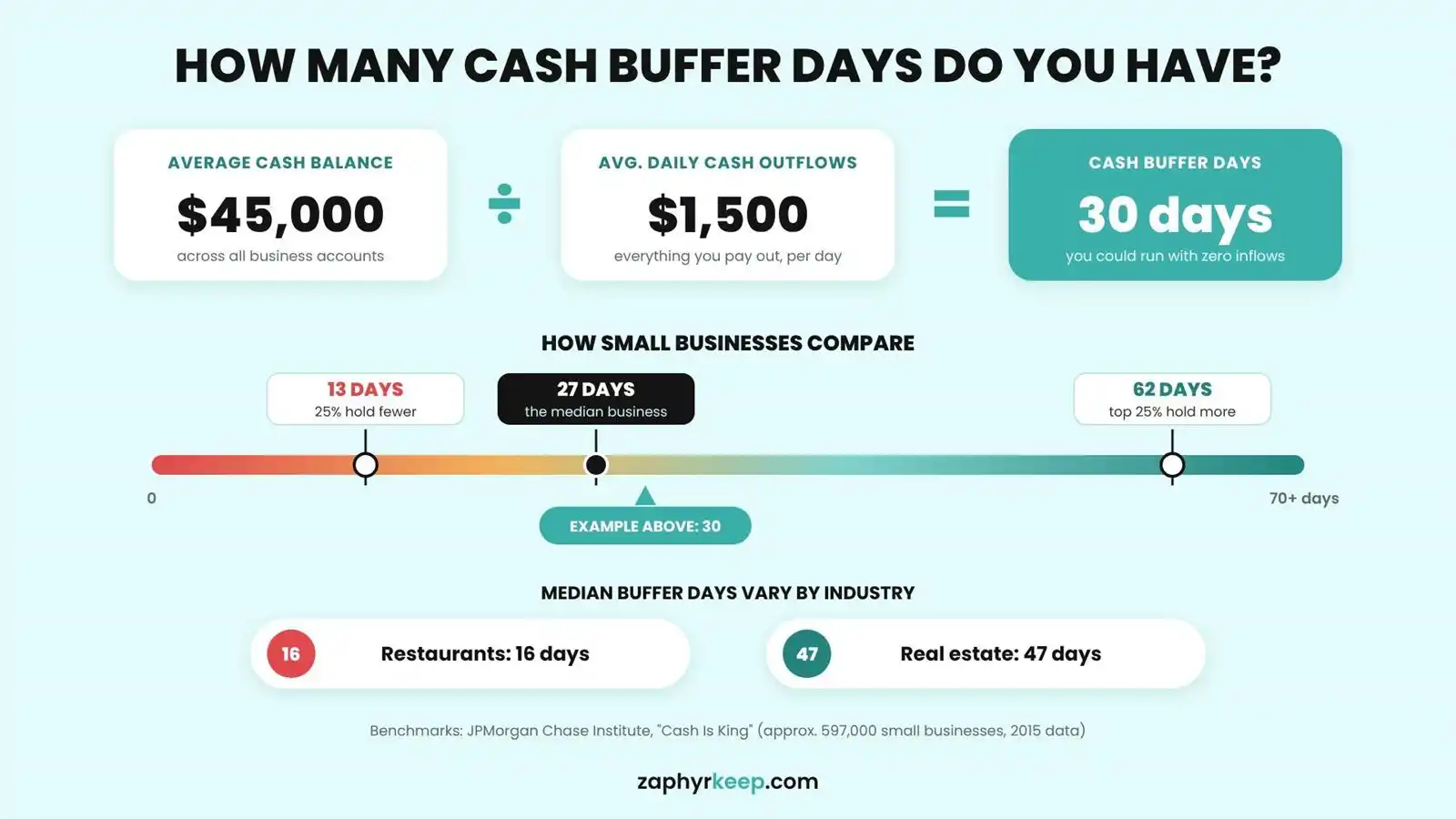
A cash reserve can turn a bad month into an inconvenience instead of a crisis, giving your business some breathing room when payments slow down or unexpected expenses come up. One practical way to measure that safety margin is in cash buffer days:
Cash buffer days = Average cash balance ÷ Average daily cash outflows
That tells you roughly how long your business could keep covering its usual expenses if cash stopped coming in. For context, a JPMorgan Chase Institute study of roughly 597,000 small businesses (based on 2015 transaction data) found the median firm held just 27 cash buffer days, while a quarter held fewer than 13. Industries vary widely: the median restaurant held 16 days, compared with 47 for the median real estate business.
To build yours:
- Calculate your current buffer days as a baseline.
- Set a target. A common rule of thumb is one to three months of operating expenses, with seasonal businesses or long collection cycles aiming higher.
- Hold the reserve in a separate business account so it doesn’t get mistaken for money available to spend.
- Automate a transfer, such as a fixed percentage of every customer payment.
- Refill it after use, just like any other priority bill.
6. Plug Cost Leaks and Revisit Your Pricing
Cash flow optimization isn’t only about timing. Sometimes the business simply keeps too little of what it earns, and that’s where controlling costs and reviewing prices can make a difference.
- Audit recurring charges. Pull a vendor spend report from your small business accounting software and review every subscription and auto-renewal each quarter.
- Renegotiate fixed costs such as insurance, rent, and vendor contracts when they come up for renewal.
- Review pricing at least once a year. Rising costs of goods, services, and wages were the most common financial challenge in the Federal Reserve Banks’ 2026 Report on Employer Firms, cited by 73% of firms, while 48% of firms facing financial challenges responded by raising prices. If your costs have gone up but your prices haven’t, your margins are taking the hit.
- Check profitability by customer or service line. Some accounts may cost more to serve than they bring in.
- Watch inventory. Stock sitting on a shelf ties up cash you could be using elsewhere.
7. Set an Owner Pay Policy and Line Up Backup Funding Early
Owner pay is where personal and small business financial management often blur, and it’s one of the habits that can separate businesses that ride out a slow season from those that scramble when cash gets tight.
First, pay yourself on a schedule. For owners who take draws, withdrawing money whenever the balance looks healthy can quietly drain the cash your cash flow planning depends on. Set a fixed amount, or a formula tied to actual cash available, and document a minimum balance the business must keep before any draw.
Second, arrange a line of credit while your numbers look strong. It’s generally easier to qualify before you urgently need the money, though approval depends on your financial position. Use it for short-term cash flow gaps rather than relying on borrowed money to cover ongoing losses.
Cash Flow Metrics Every Small Business Should Track
Small business financial management gets far easier when you watch a short list of numbers regularly instead of reacting to the bank balance. These six metrics help you see whether your cash flow optimization efforts are actually working.
|
Metric
|
Formula
|
What it tells you
|
|---|---|---|
|
Operating cash flow
|
Cash received from operations - cash paid for operations
|
Whether the core business generates cash on its own
|
|
Days sales outstanding (DSO)
|
(Average accounts receivable ÷ Net credit sales) × Days in period
|
How long it takes to collect customer payments
|
|
Days payable outstanding (DPO)
|
(Accounts payable ÷ cost of goods sold) × days in period
|
How long you take to pay suppliers
|
|
Days inventory outstanding (DIO)
|
(Average inventory ÷ Cost of goods sold) × Days in period
|
How long inventory stays on hand before being sold
|
|
Cash conversion cycle
|
DIO + DSO - DPO
|
How long cash is tied up between paying suppliers and collecting from customers
|
|
Cash buffer days
|
Average cash balance ÷ average daily outflows
|
How long you could cover expenses if inflows stopped
|
Ideally, these numbers are reviewed regularly through your monthly financial reports, alongside the rest of your small business accounting. A shrinking cash conversion cycle and a growing cash buffer are useful signs that your plan to improve cash flow is moving in the right direction.
Where to Start
Cash flow problems rarely happen overnight. They build up through late invoices, bills paid too early, accounts that haven’t been reconciled, and withdrawals made without much thought about what’s coming next. The good news is that small changes in how you manage your money can make a real difference over time.
You don’t have to tackle all seven strategies at once. Start with whatever is putting the most pressure on your cash right now, whether that’s keeping up with receivables or getting a clearer picture of the weeks ahead, and build from there. Good cash flow planning isn’t about making things complicated; it’s about knowing where your money stands and feeling more prepared for what’s next.
And if keeping up with the books is already taking more time than you’d like, you don’t have to figure everything out on your own. At ZaphyrKeep, we help small business owners keep their records organized, accounts reconciled, and finances easier to understand. Let’s talk about what your business needs and how we can help take some of that work off your plate.
Frequently Asked Questions
What is cash flow planning for a small business?
Cash flow planning means forecasting when money will come into your business and when it needs to go out, so you can spot potential shortfalls before they happen. A rolling 13-week forecast is one practical approach, using reconciled bank balances, realistic customer payment dates, and expected expenses like payroll, rent, taxes, and owner draws where applicable.
What are the fastest ways to improve cash flow?
Some of the quickest ways to improve cash flow start with receivables: send invoices as soon as work is delivered, follow up on overdue payments regularly, ask for deposits on larger jobs, and make it easy for customers to pay through ACH. On the expense side, schedule bills for their due dates rather than paying them as soon as they arrive.
What is the difference between cash flow management and cash flow optimization?
Cash flow management is the day-to-day work of tracking money coming in and going out. Cash flow optimization takes that a step further by improving the timing and amount of those flows, whether that’s collecting payments sooner, negotiating better terms, or cutting unnecessary expenses so the business has more usable cash.
How much cash reserve should a small business keep?
A common rule of thumb is one to three months of operating expenses, with seasonal businesses or those facing long collection cycles often needing more. You can measure your reserve in cash buffer days: average cash balance divided by average daily outflows. A JPMorgan Chase Institute study using 2015 transaction data found that the median small business held 27 buffer days.
How often should I update my cash flow forecast?
Weekly. Replace estimates with actual results, drop the oldest week, add a new one at the end, and note where you were off. Weekly updates keep cash flow planning accurate enough to act on; very stable businesses may manage with monthly reviews.
Can a profitable business have negative cash flow?
Yes. Under accrual accounting, profit reflects revenue earned and expenses incurred, while cash flow tracks when money actually moves. Slow-paying customers, inventory purchases, loan principal payments, and owner draws can all leave a profitable business short on cash. That’s why it’s important to track profitability and cash flow separately.