
I’ve closed the books for enough small businesses to know exactly how December feels from the owner’s side. The holidays arrive, the inbox fills with “quick” requests, and somewhere in the back of your mind, a quiet voice keeps reminding you the year still isn’t closed.
Here’s what I’ve learned after doing this year after year: the owners who dread year-end aren’t necessarily short on talent or budget. They’re treating one long sequence of small, ordered steps as a single giant task. When I walk a client through that sequence in the right order, closing the year stops being a scramble and turns into a handoff. The difference comes down to having a clear year end bookkeeping checklist and working through the time-sensitive steps before December 31.
So that’s what I want to give you here: the exact sequence I run, what to reconcile, what to adjust, which forms to prepare, what changed for 2026 or beyond, and the handful of mistakes I see quietly undo an otherwise clean close. Whether you keep your own books or hand them off, by the end you’ll know what a complete year end accounting checklist looks like and where I most often see the process break down.
Key Takeaways
- A structured year end bookkeeping checklist turns tax prep from a scramble into a smoother handoff to your accountant.
- I run every close in three stages: reconcile, adjust, then review and lock. The key is making time-sensitive tax decisions before December 31 while completing the remaining close activities in January.
- Several 2026 rules changed: the 1099-NEC reporting threshold increased from $600 to $2,000, the Section 179 deduction limit rose to $2.56 million, and the 401(k) employee deferral limit climbed to $24,500.
- The most common errors I see, recording net-of-fee deposits, mixing personal expenses with business transactions, and leaving accounting periods unlocked, can be prevented with a consistent small business accounting checklist.
What a Year-End Close Actually Means
When I say a year-end close, I mean finalizing your books so every account is accurate, reconciled, and ready for review before the financial records go to a tax preparer. It’s really a bigger version of the month-end close I run for clients, with extra steps layered on for payroll forms, contractor reporting, inventory, fixed assets, and tax planning.
For a calendar-year business, the close covers January 1 through December 31. Most of the mechanical work, matching statements, categorizing stragglers, and running reports, I can do in the first few weeks of January. But some tax-saving decisions have a hard deadline: they must be made before December 31.
Miss that window, and certain options may no longer be available for the year, yes.
That split is the single most useful thing I can hand you about any year end close checklist. Some tasks wait until January. Others need attention before December 31. Once you separate the two early and build both into one year end bookkeeping checklist, you’re far less likely to be caught off guard. And don’t worry, I’ll walk you through both, so you know exactly what needs to happen, when, and why.
Why the Order of Your Year End Bookkeeping Checklist Matters
Plenty of businesses already have a checklist. Far fewer work it in sequence, and that’s where I see most of the pain come from. Run your profit-and-loss statement before the accounts are reconciled and you’re reviewing numbers that aren’t finalized, making decisions based on figures that could change the moment a missing transaction surfaces.
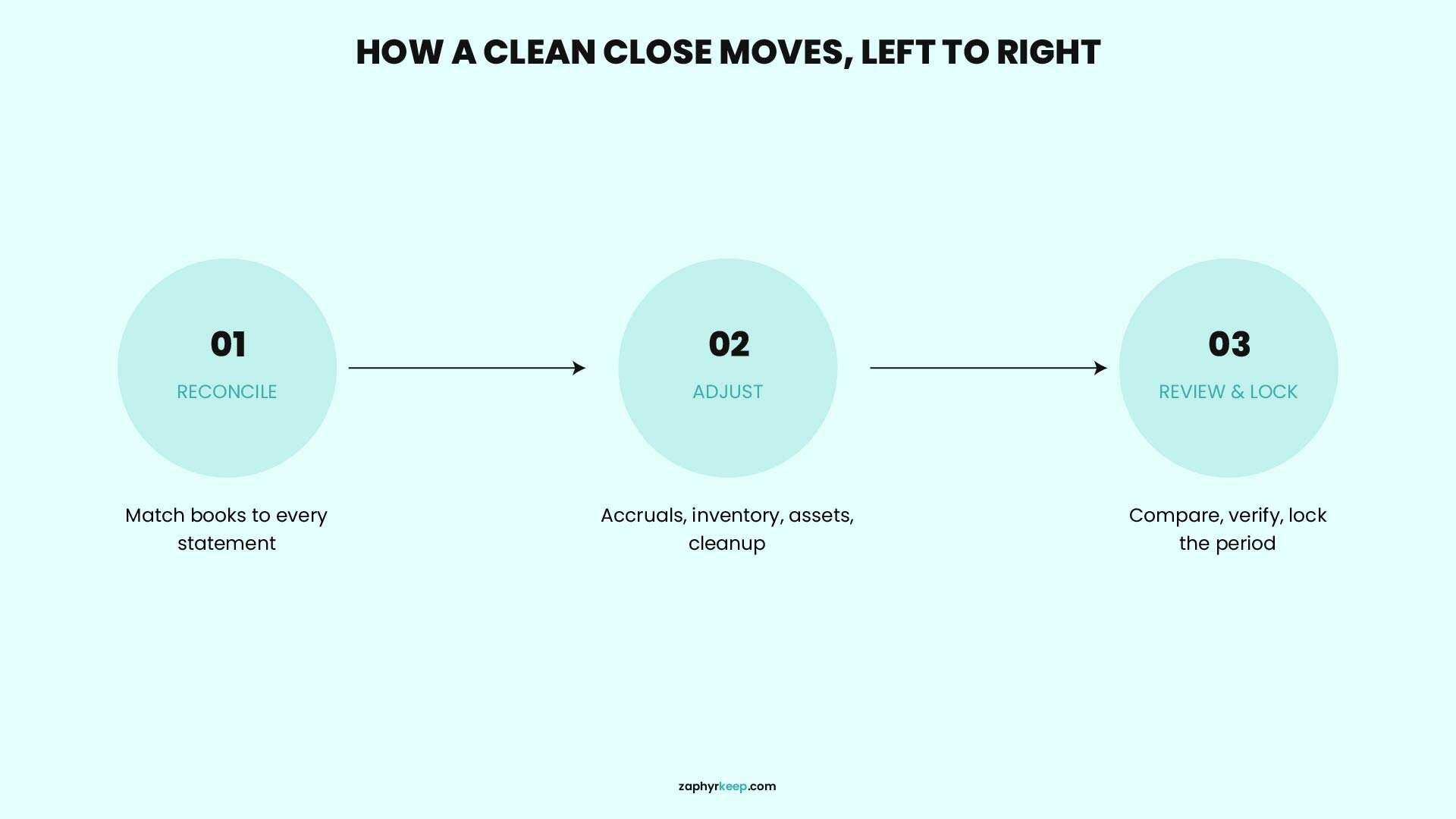
So I keep this year end bookkeeping checklist deliberately staged. First, I make the raw data trustworthy (reconcile). Then I correct timing and categorization (adjust). Only then do I analyze and lock the books (review and lock). In that order, every step builds on accurate financial records.
Before you start
If the books are months behind, I never try to close and catch up at the same time. I bring every month current first, then run the close once, because doing both at once is where whole weekends disappear. The step that trips people up most is matching the books to the bank, so it’s worth getting comfortable with how a bank reconciliation works before you start.
Stage 1: Reconcile Every Account
Reconciliation is where I start every year end accounting checklist, because it’s the foundation everything else sits on. All it means is matching what the books say against what actually happened in the real world, using bank statements, card statements, and loan balances. If those don’t agree, I can’t fully trust the financial reports built on top of them.
Accounts to reconcile before close
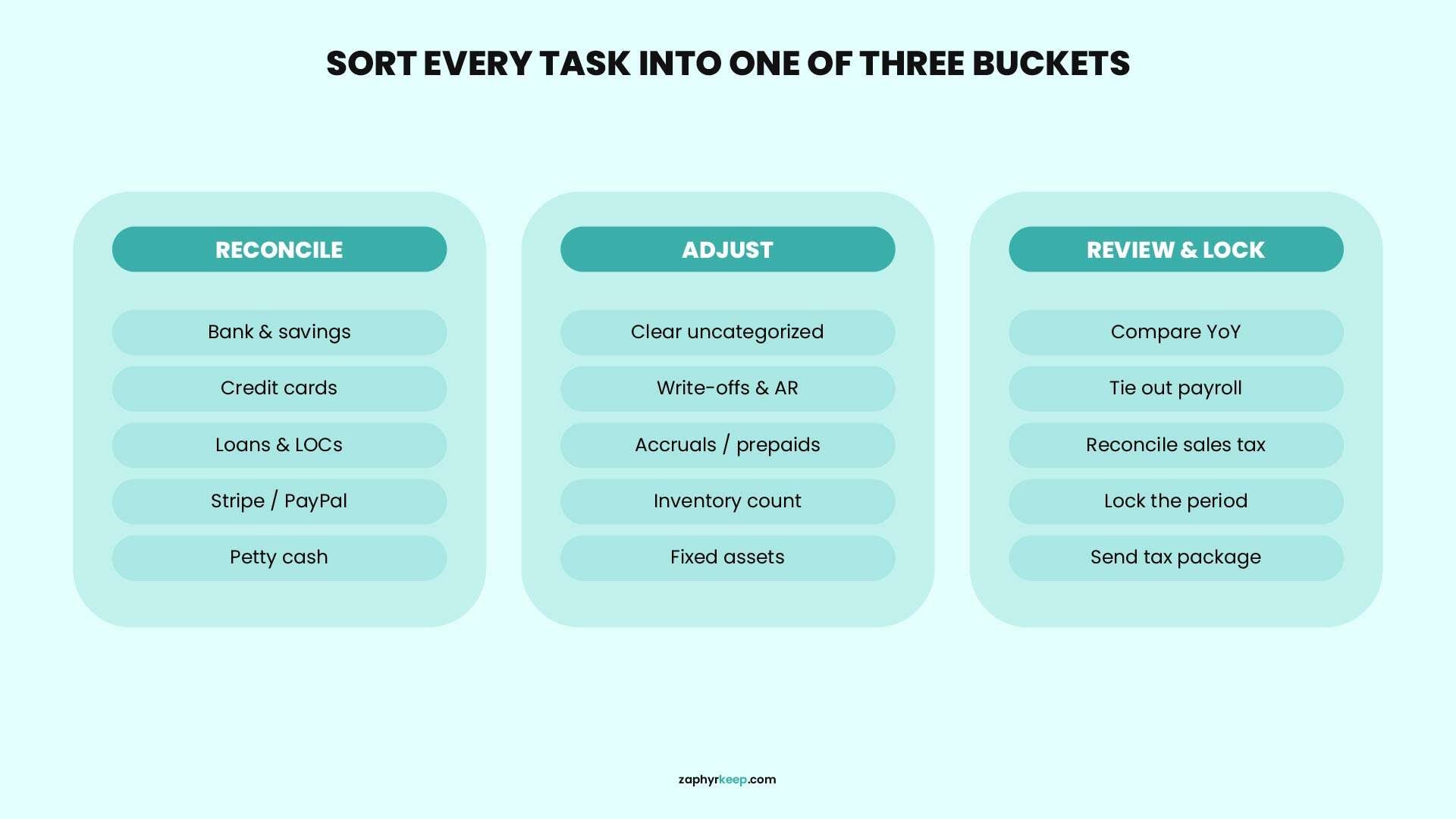
- Bank accounts – Match every checking and savings account to its year-end statement, accounting for outstanding checks and deposits in transit.
- Credit cards – Reconcile each card, including any cards carried by employees.
- Loans and lines of credit – Split each payment between principal and interest, and tie the ending balance to the lender’s year-end statement.
- Payment processors – Reconcile Stripe, PayPal, Square, or Shopify so gross sales, processing fees, and refunds are recorded correctly, not just the net payout that lands in your bank.
- Petty cash and clearing accounts – Match petty cash to a counted, documented balance and investigate any outstanding clearing account balances.
The processor line is the one I catch small businesses missing most. When only the net deposit from Stripe gets recorded as income, the platform’s fees and refunds aren’t properly reflected in the books, potentially understating gross revenue and processing expenses. On any small business accounting checklist I build, that’s a non-negotiable catch.
Do this throughout the year, not just in December
The reason my clients stay calm in Q1 is that I reconcile their accounts every month, so year-end is a formality rather than a marathon. Twelve clean month-end closes make the annual one almost automatic.
Stage 2: Clean Up and Adjust
Once the data is trustworthy, I move to the part of the year end close checklist that fixes what reconciliation can’t: timing, categorization, and the adjusting entries needed to finalize the year.
Cleanup and adjusting entries
- Clear uncategorized items. Review and resolve balances in suspense or “Ask My Accountant” accounts, and properly categorize transactions recorded under miscellaneous.
- Review receivables. Follow up on overdue invoices, and if you use accrual accounting, review potentially uncollectible debts for appropriate write-offs.
- Record unpaid bills. If you use accrual accounting, record eligible December expenses billed in January so they fall into the correct accounting period.
- Book accruals and prepaids. On the accrual method, review and record deferred revenue, prepaid expenses, and accrued costs as applicable.
- Count inventory. Conduct a year-end physical inventory count, reconcile discrepancies, and review damaged or obsolete stock for appropriate valuation adjustments.
- Update the fixed-asset list. Add this year’s purchases, remove anything sold or scrapped, and record applicable depreciation.
- Separate owner transactions. Identify personal spending in business accounts and correctly classify owner draws, contributions, or S-corp distributions.
This is the stage where a year end accounting checklist earns its keep. Each item looks small, but together they help ensure your financial records accurately reflect the business and support tax preparation. The owner-transaction cleanup matters more than most people expect, because personal spending incorrectly recorded as business expenses can inflate deductions you can’t support and blur the line between you and the company, which is one of the first things I untangle in a messy set of books.
Stage 3: Review and Lock
Now, and only now, do I analyze. With the data clean and the adjustments posted, the final stage of the year end close checklist is confirming the whole picture holds together, then locking the books to prevent unintended changes.
Review and lock the year
- Compare year over year. Run this year’s P&L and balance sheet beside last year’s and investigate any significant changes.
- Tie payroll to filings. Reconcile wages, payroll taxes, and benefits in your books with quarterly Forms 941 and annual W-2 totals, accounting for any differences.
- Reconcile sales tax. Match sales tax collected and payable against filed returns and payments made in each applicable state.
- Lock the period. Once the final adjustments, including those from your tax preparer, are recorded, set a closing or lock date in your accounting software to prevent accidental changes to 2026 transactions.
- Send a clean package to your preparer. Include financial statements, reconciliations, the fixed-asset list, and payroll reports.
Locking the period is the step I watch owners skip most and regret most, and it’s the real finish line of any year end close checklist. An accidental edit to a closed year after the return is filed can leave the books and the tax return out of sync, and I can tell you that untangling it months later takes far more effort than setting a lock date.
One pattern I’ll flag here: when someone runs their first close and the P&L looks off, I often find reconciliation gaps or misclassified transactions behind the discrepancies. The fix starts with accurate monthly financial statements you can trust year-round, so the year-end review becomes confirmation rather than discovery.
Payroll and Contractor Forms
Payroll carries some of the strictest deadlines of the whole close, with little room for error, because mistakes can affect tax reporting and employees’ individual returns. This is the section of my small business accounting checklist I always start earliest.
Payroll & 1099 checklist
- Verify employee details. Confirm legal names, addresses, and Social Security numbers before preparing W-2s.
- Reconcile payroll to the ledger. Match wages, payroll taxes, and benefits in the books against year-to-date payroll records, accounting for any differences.
- Account for fringe benefits. Make sure taxable benefits, such as personal use of a company car or taxable group-term life insurance, are properly reflected in payroll and W-2 reporting.
- Process year-end bonuses. Ensure bonuses are paid and reported in the correct tax year, following applicable payroll and accounting rules.
- Collect missing W-9s. Obtain valid W-9 information from contractors whose payments may require reporting on Form 1099-NEC.
- Exclude qualifying card and third-party network payments from 1099-NEC. Payments made by credit card or through qualifying third-party payment networks, such as certain PayPal transactions, fall under Form 1099-K reporting rules rather than Form 1099-NEC.
- S-corp owners. Confirm reasonable compensation was processed through payroll and that applicable company-paid health insurance premiums for shareholders owning more than 2% are reported on Form W-2.
The 1099 rule changed this year
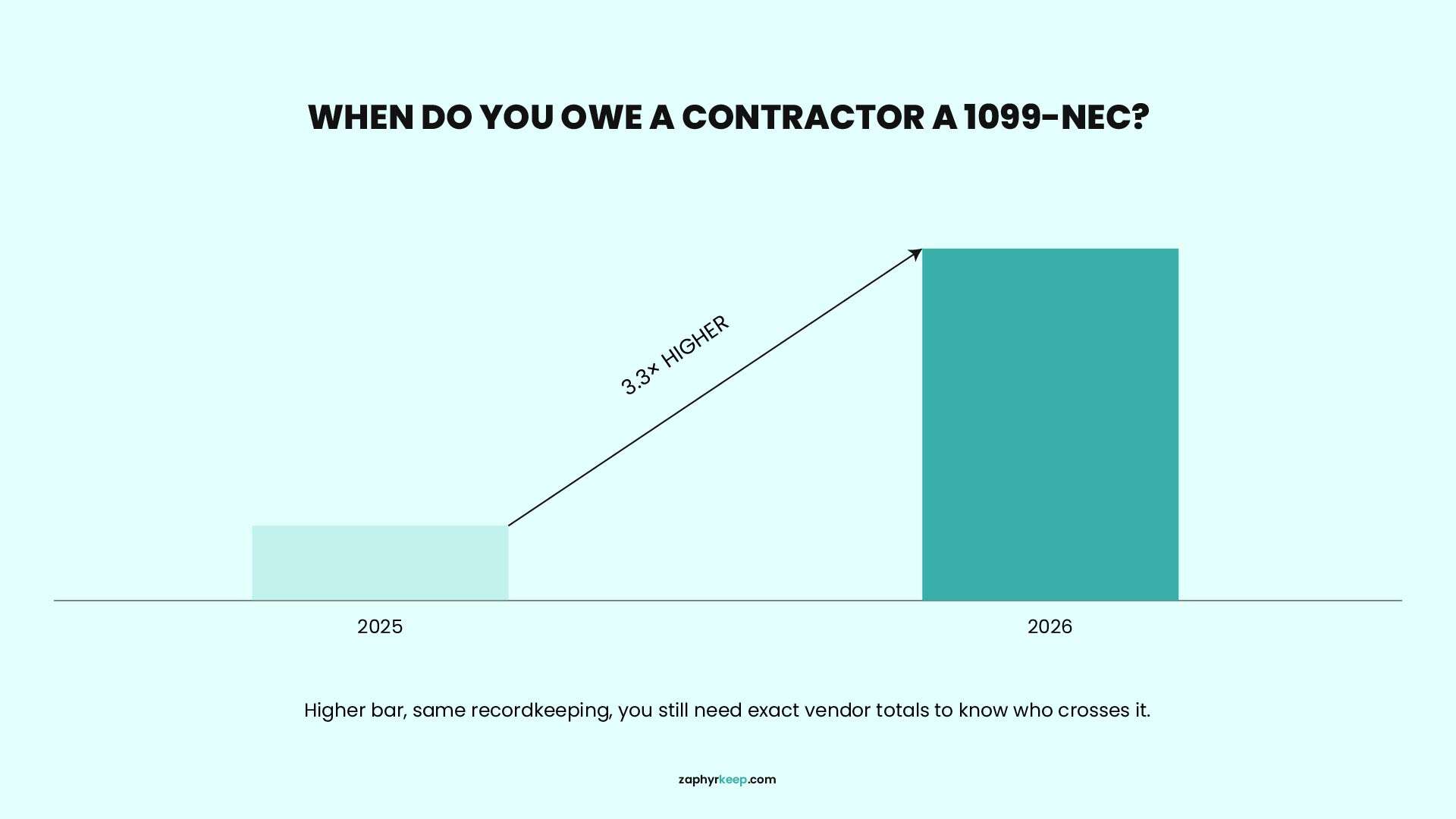
For payments made in 2026, businesses generally need to issue Form 1099-NEC when they’ve paid a contractor $2,000 or more in reportable compensation during the year, up from the long-standing $600 threshold. The threshold is higher, but accurate recordkeeping still matters because you need reliable vendor totals to know who crosses the line.
If payroll runs on a separate platform, this is also when I confirm the books and the payroll system actually agree, because the two drifting apart is one of the quieter ways a close goes wrong. Which platform you’re reconciling against matters here too, and the trade-offs between two popular payroll tools, Gusto and QuickBooks, come down to the kind of team you’re running.
Tax Planning Steps to Complete Before Year-End
This is the part of the year end accounting checklist I flag hardest, because some tax-saving decisions have a true expiration date. Once the calendar turns, certain options are gone for the year, so I want these decisions reviewed early and the time-sensitive ones handled before December 31.
Decide before the clock turns over
- Place equipment in service. Section 179 lets eligible businesses deduct up to $2.56 million for 2026, and permanent 100% bonus depreciation applies to qualifying property. The catch: the asset generally has to be placed in service by December 31, not merely ordered.
- Time income and expenses (cash method). Paying eligible deductible expenses in December may bring the deduction into this year. Income generally counts when it’s actually or constructively received, not simply when an invoice is sent.
- Review retirement contributions. For 2026, employees can defer up to $24,500 into a 401(k), plus an $8,000 catch-up at age 50 or older, or an enhanced $11,250 catch-up at ages 60–63. The combined employee and employer contribution limit is generally $72,000, excluding catch-up contributions. Employee deferrals generally need to be arranged before year-end, while some employer contributions can be made later.
- Review estimated taxes. Calendar-year C corporations generally owe their final estimated tax installment on December 15, 2026. Individuals, including many pass-through business owners, generally have until January 15, 2027, for their fourth-quarter estimated payment.
- Decide your 2027 structure. If an S-corp election makes sense, note that Form 2553 is generally due by March 15, 2027, for a calendar-year business seeking an election effective January 1, 2027.
A clean close is the cheapest tax planning there is
I can’t make informed tax-planning decisions on bad data, and neither can you. There’s no deciding whether to buy equipment or defer income without understanding your actual profit and cash flow first, which is exactly why I put the reconcile-and-adjust stages ahead of this one.
What Changed for Year-End 2026
Tax figures change every year, and several updates to the 2026 tax rules are significant enough that I’ve already adjusted how I approach this year’s close. These are the numbers I’m factoring into every year end bookkeeping checklist right now.
|
Area
|
What changed for 2026
|
|---|---|
|
Contractor reporting
|
The 1099-NEC and several 1099-MISC reporting thresholds increased from $600 to $2,000 for payments made in 2026, with certain exceptions.
|
|
Section 179
|
Expensing limit of $2.56 million, with the phaseout starting at $4.09 million.
|
|
Bonus depreciation
|
100% bonus depreciation is now permanent for qualifying property.
|
|
401(k) deferrals
|
Employee deferral limit rose to $24,500; combined defined-contribution limit is $72,000.
|
|
IRA limits
|
Traditional and Roth IRA contribution limit increased to $7,500.
|
|
Catch-up (ages 60-63)
|
An enhanced catch-up of up to $3,250 applies on top of the standard $8,000.
|
I’d update these figures in your year end accounting checklist before making any purchasing or payroll decisions, because the numbers that drove last year’s close simply don’t apply this cycle.
The Year-End Deadline Calendar
I always tell clients that a year end close checklist works best when every task has a clear deadline. Some decisions need attention before December 31, while others can wait until the new year. These are the key dates I build each client’s year-end close around.
|
Timeframe
|
What's due
|
|---|---|
|
Mid-December
|
Fourth-quarter estimated tax payment for calendar-year C corporations.
|
|
December 31
|
Year-end cutoff for placing qualifying equipment in service, paying eligible deductible expenses (cash method), and processing payroll payments intended for 2026.
|
|
Mid-January
|
Fourth-quarter estimated tax payment for individuals, including many sole proprietors and pass-through business owners.
|
|
End Jan / early Feb
|
W-2s to employees and the SSA; 1099-NEC to contractors and the IRS; fourth-quarter Form 941 and annual Form 940, where applicable.
|
|
March
|
Calendar-year partnership and S-corp returns; generally, Form 2553 for an S-corp election effective January 1, 2027.
|
|
April
|
Individual and calendar-year C-corporation federal income tax returns; first estimated tax payment for 2027.
|
Exact dates shift with weekends and holidays
When a filing deadline falls on a Saturday, Sunday, or applicable legal holiday, it generally moves to the next business day. I confirm the exact dates each year rather than relying on last year’s calendar, which gives business owners one less thing to track and helps reduce the risk of filing late.
Mistakes That Quietly Undo a Clean Close
Even a thorough year end bookkeeping checklist can be undermined by the same handful of errors, and I run into them regularly. Each one looks minor in the moment but can lead to costly corrections later.
The five most common close-killers
- Booking net deposits from processors. Recording only the net Stripe or PayPal payout as revenue can hide processing fees and refunds, understating gross income and leaving expenses or refunds improperly recorded.
- Leaving personal spend in the books. Personal expenses incorrectly classified as business expenses can inflate deductions you can’t support and blur the separation between you and the business.
- Deducting equipment that was only ordered. Equipment generally needs to be placed in service by December 31 to qualify for depreciation deductions that year. Ordering it alone isn’t enough.
- Forgetting to collect W-9s until January. Chasing contractor tax IDs during filing week increases the risk of reporting errors and missed deadlines.
- Never locking the period. An accidental edit to a closed year after filing can leave your books and tax return out of sync.
Notice the pattern: None of these mistakes is especially complicated, but they can create unnecessary cleanup. They’re often the result of inconsistent bookkeeping, the kind of issues that become easier to prevent when someone manages the books every month instead of once a year. When I follow the same year end bookkeeping checklist each cycle, I can catch these discrepancies before they turn into bigger issues.
DIY, In-House, or Outsourced?
By now, the real question isn’t what needs to be done at year-end, but who’s actually going to handle it, and when. I usually walk clients through three options, and the right fit comes down to your transaction volume, the complexity of your books, and how much of December you want back.
|
Approach
|
Best when
|
The trade-off
|
|---|---|---|
|
Do it yourself
|
Low transaction volume, simple business structure, and you're comfortable managing the details.
|
Your time is the biggest commitment, especially during busy periods.
|
|
In-house hire
|
High transaction volume, complex operations, and ongoing financial management needs.
|
Salary, benefits, and potential coverage gaps when your bookkeeper is unavailable.
|
|
Outsourced team
|
You want accurate monthly bookkeeping without building an internal department.
|
Less day-to-day oversight in exchange for predictable pricing and ongoing professional support.
|
There’s no universally right answer, only the right fit for your stage, and whichever path you pick the same small business accounting checklist still has to get worked. The only real question is whose desk it lands on. If you’re torn between the last two, the actual cost of outsourcing versus hiring in-house is worth running the numbers on before you commit either way.
Would you rather hand the whole close off?
That’s exactly what we do here at ZaphyrKeep. We reconcile, adjust, and review your books throughout the year, making the year-end close a smoother process rather than a last-minute scramble. Our plans scale with your transaction volume, and every engagement starts with a free consultation.
Frequently Asked Questions
When should a small business start its year-end close?
Small businesses should start their year-end close in November, complete time-sensitive tax decisions by December 31, and finalize reconciliations in January. For the 2026 tax year, W-2s and 1099-NECs are generally due February 1, 2027. Regular monthly bookkeeping can significantly shorten the closing process.
What's the difference between a year end bookkeeping checklist and a month-end close?
A month-end close reconciles accounts and reviews results each month. A year end bookkeeping checklist adds the annual-only work: inventory counts, depreciation, payroll and contractor forms, tax-planning decisions, and locking the period. Twelve clean month-end closes are what make the year-end version fast, which is why I keep clients on a monthly rhythm.
Do sole proprietors really need to close their books?
Yes. Even filing on Schedule C, your tax return is only as accurate as your books. Reconciled accounts are also your strongest support if the IRS ever asks questions, so I’d run a simple small business accounting checklist regardless of structure.
Can I deduct equipment I buy in late December?
You can, as long as it’s placed in service by December 31. Equipment ordered in December but not delivered and ready to use until January counts for the following tax year, not the current one. “Placed in service” is the phrase that matters, not the purchase date, and it’s one I double-check often.
What happens if I skip the lock step on my year end close checklist?
Nothing, until someone edits a transaction in the closed year after you’ve filed. At that point the books and the tax return no longer match, and reconciling the difference later is far more work than setting a lock date takes now. I treat it as the cheapest insurance in the whole process.
Is it worth outsourcing the year-end close?
For a lot of owners, yes, especially when the close eats days you’d rather spend running the business, or the books fall behind during busy months. Keeping them current all year means the year end accounting checklist is essentially finished before December, which is the whole reason the outsourced model works.